
By August 2026, the EU AI Act will fundamentally reshape the AI startup landscape. Some founders will turn regulation into a valuation and market-access advantage, while others risk funding delays, lost contracts, or fines up to €35M. This transition alters how startups secure venture capital and close enterprise deals: compliance is no longer just a legal formality, but a critical operational factor.
To address these market changes, UAtech Strategic Advisor Yuliya Dmytryshyn moderated a discussion with Yuliia Habriiel, partner & CEO of eyreACT.com; Anna Dymowska, Partner at Fundingbox Deep Tech Fund; and Théophile Maiziere, EU Policy Manager at techUK.
In this article:
- Funding Prerequisites: Why investors now demand a compliance roadmap.
- The Real Compliance Timeline: Why Q3 2026 is the critical cutoff
- Using Compliance to Win Partnerships
- Execution: A practical 90-day action plan for founders.
Watch the full webinar on YouTube
- Why Investors Now Demand an EU AI Act Roadmap Before Writing Checks
While private angels might still tolerate operational ambiguity, institutional investors have shifted their stance. For these players, compliance is no longer optional – it is a baseline requirement for capital deployment.
“Public investors cannot afford to have high risk acceptance due to the obligations of public money” –
Explains Anna Dymowska, Partner at Fundingbox Deep Tech Fund.
Consequently, the “blind investment” era – where capital followed a good idea regardless of governance – is ending for major rounds. The larger the capital involved, the more critical and thorough the due diligence becomes.
This scrutiny now extends to the startup’s underlying technology stack and third-party providers. A startup is now only as investable as its least compliant vendor. Anna Dymowska, Partner at Fundingbox Deep Tech Fund, warns:
“You should not buy an AI that is not compliant... we will need to make deeper due diligence of our providers.”
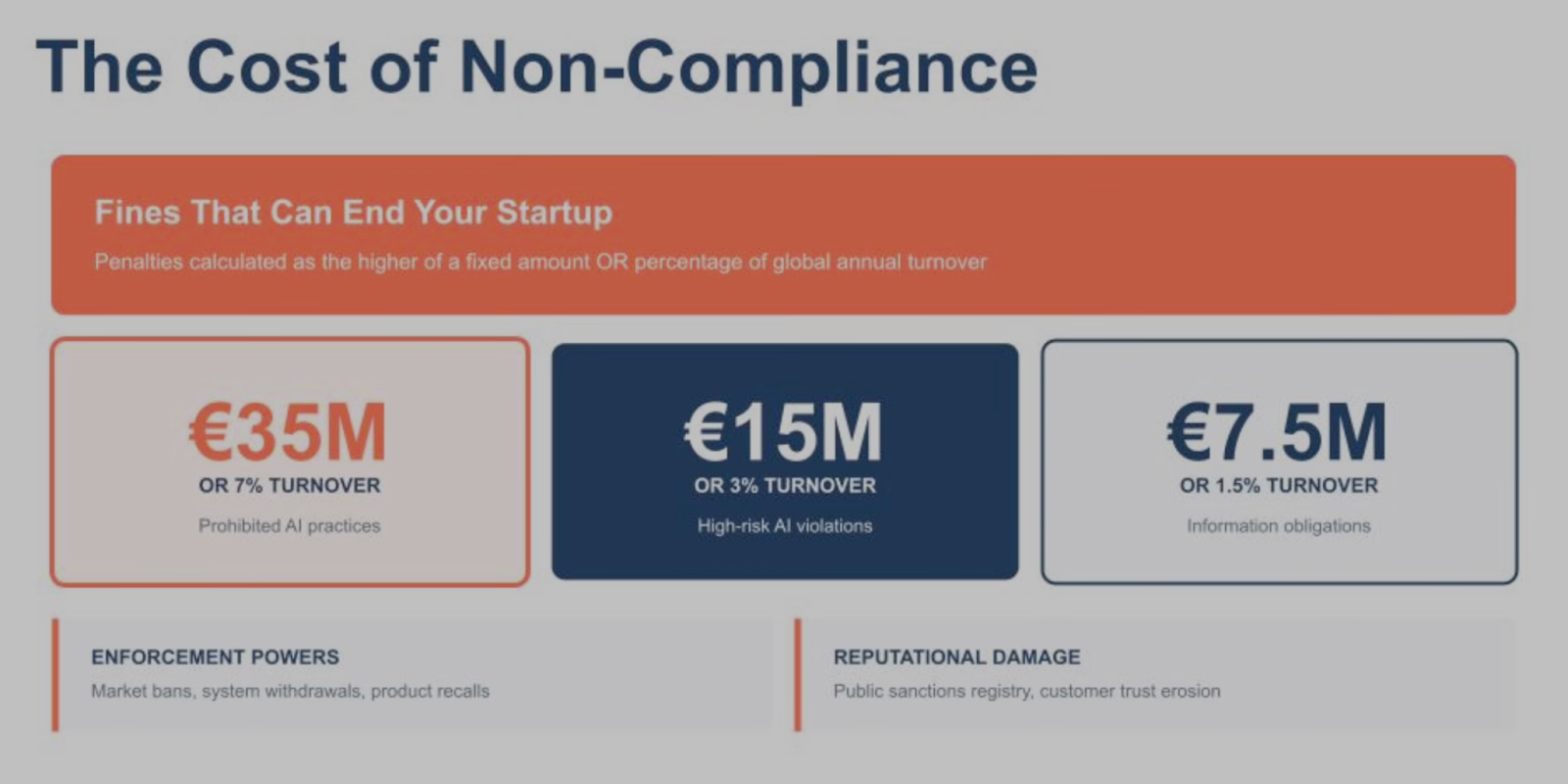
- Why Q3 2026 Is The Critical Cutoff
The enforcement deadline is fixed for August 26, 2026. With the clock ticking, the operational reality dictates immediate action. Yuliia Habriiel, CEO of eyreACT.com, states that constructing a defensible compliance framework takes “from six to 12 months... and that's with expensive help”.
Founders adopting a "wait and see" approach are running out of runway. Théophile Maiziere, EU Policy Manager at techUK, warns against banking on political delays or guideline updates. Even if nuances shift, the core assessment duties will not. He advises:
“Don't base your compliance on hypothetical developments... whatever happens, you're going to have to do that work already by that August 2026 deadline”.
The timeline allows no room for last-minute retrofitting. The law doesn't care about your roadmap; if you aren't ready by the deadline, you are out of the market.
- Using Compliance to Win Partnerships
A common misconception among founders is that the EU AI Act only applies to companies physically headquartered in Europe. Théophile Maiziere, EU Policy Manager at techUK, dispels this myth: the regulation is defined by the impact of the output, not your location.
“If the output ends up leading to influencing decisions happening in the EU, you're going to be covered,” – Théophile Maiziere warns.
Whether you have one client in Europe or your algorithm affects a user there, you fall under the scope.
For startups, this is a significant advantage. Enterprise clients are prioritizing vendors who can prove their AI “won't mess up someone's production”. By guaranteeing a verified, compliant framework, you remove liability for your partners, fast-tracking the sales cycle ahead of competitors who remain a regulatory risk.
- 90-day Action Plan for Founders
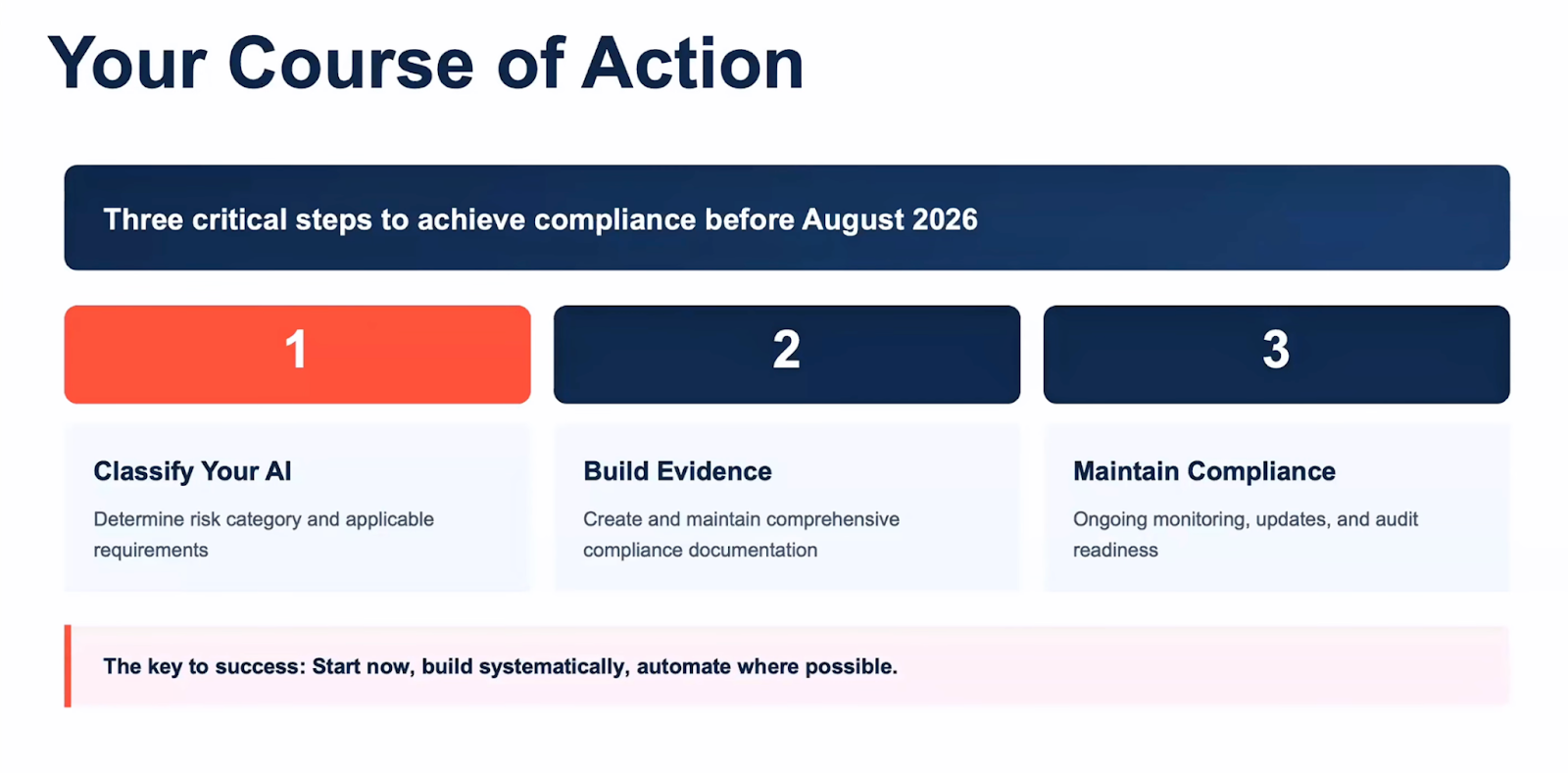
To avoid the "wait and see" trap, Yuliia Habriiel, partner & CEO of eyreACT.com, outlines three essential steps to operationalize compliance immediately.
Step 1: Classify Your AI
Startups often approach this in the “wrong order”, jumping to documentation before understanding their status. Habriiel notes that many founders classify their systems as low risk “because they want to be... not because they actually are”.
- Action: Determine if you fall into High Risk (e.g., employment, education, critical infrastructure).
- Rule: “Do not guess”. If in doubt, double-check answers, as incorrect classification is a violation.
Step 2: Build Evidence
Founders must create a “compliance binder” covering the entire development lifecycle.
- Requirements: Technical documentation, risk management, data governance, and human oversight.
- Timing: You cannot retrofit documentation after the fact. Evidence must be tracked as you develop because that never works if done later.
Step 3: Maintain Compliance
Compliance is not a “one time achievement” or a “checkbox”. It requires ongoing post-market monitoring.
- The Cycle: Every model update or product decision requires documentation updates.
- Urgency: You have a strict 15-day window to report incidents.
- Process: Manual tracking will “kill your velocity”. To remain audit-ready, systems should be automated rather than relying on spreadsheets.
Conclusion
The EU AI Act extends far beyond a bureaucratic "legal checkbox"; it encompasses the ethical and geopolitical dimensions of how technology impacts real lives. It acts as a market filter, distinguishing reliable partners from high-risk assets. Ultimately, compliance is about responsibility – ensuring that private interactions do not turn into silent data leaks or unauthorized profiling vectors. The winners will not just be those who avoid fines, but those who build transparent systems that restore societal trust in technology.
Opportunity for Startups
Our partner, eyreACT, is launching a free pilot program for startups. It’s a unique chance to get early access to cutting-edge AI compliance tools, influence the product roadmap, and receive dedicated support from compliance experts. Email hello@eyreact.com to join for free.
Co-Authors: Yuliya Dmytryshyn, Strategic Advisor at UAtech, and Erika Danaikanych