
In the last 12 months, startup funding has declined by 12%, while AI adoption has shifted from a competitive advantage to a baseline requirement. For founders, the challenge is no longer just demonstrating technological capability, but proving financial sustainability in a market where GDP growth is increasingly driven by government spending rather than private sector expansion.
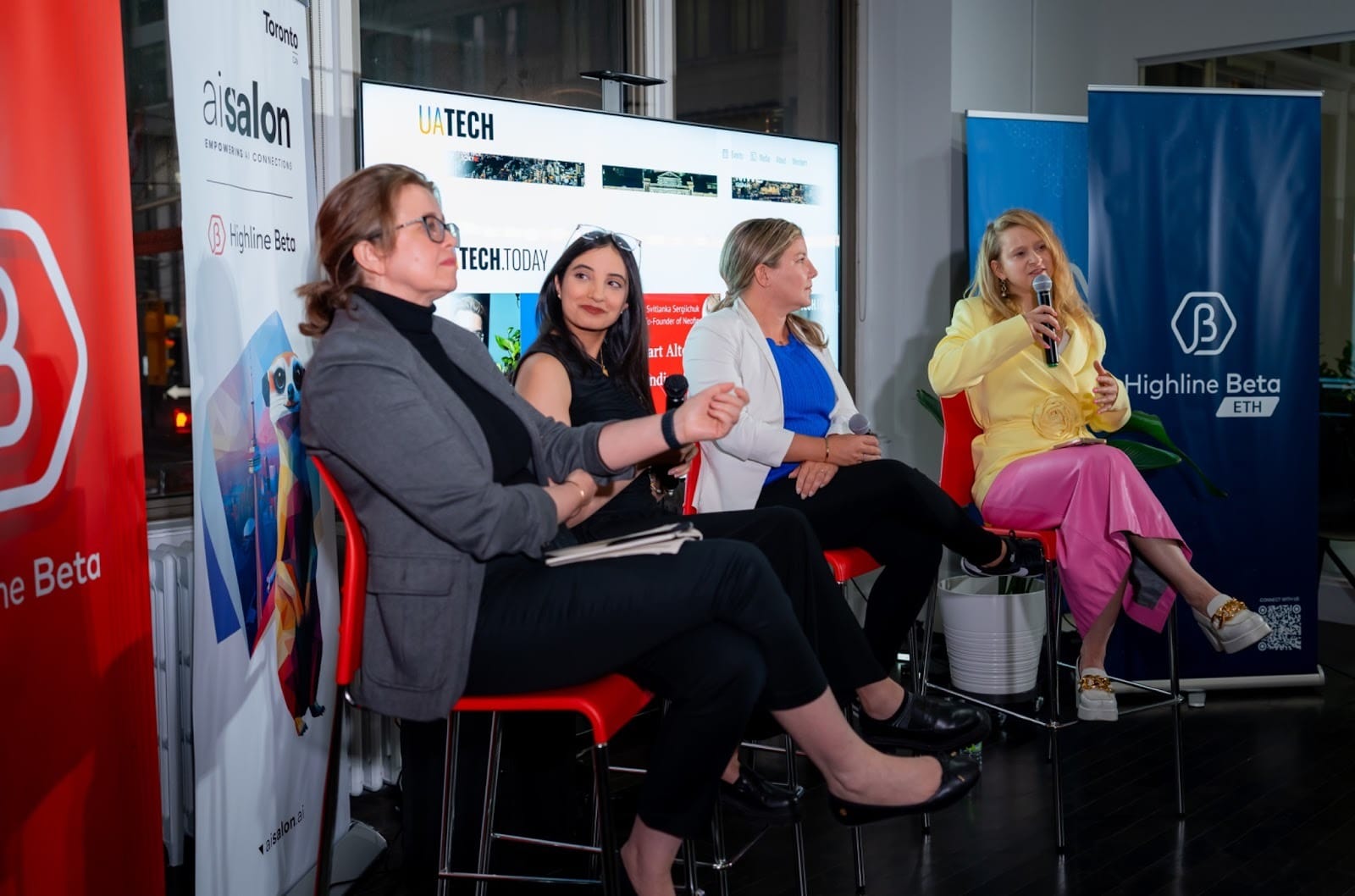
Synthesizing insights from the UAtech investment panel in Toronto – featuring leaders from the Neofin, Ontario Center of Innovation (OCI), Vistara Growth, and Finavator – we outline the strategic imperatives for founders navigating this new, disciplined landscape.

AI: From Differentiator to Baseline
Two to three years ago, before the rise of generative agents, simply applying AI was a differentiator. It was a signal of innovation that caught the attention of early-stage investors. Today, that signal has become noise.
As observed during the event’s pitch session, nearly every startup now integrates AI. Consequently, the technology itself is no longer a competitive advantage; it is the baseline. This saturation forces a critical question for founders: "What is your moat?".
Claudia Krywiak (CEO, OCI) warns that without proprietary data or unique IP, startups face existential risk from the very models they build upon.
"If you look at the very large [AI] models right now... overnight that new release can wipe out your value proposition if you are not thinking about your moat."
Beyond differentiation, the criteria for investment have expanded to include rigorous data governance. Investors now demand clear strategies on security, recognizing that "all AI is going to be using our personal data," making trust and governance non-negotiable.
However, the risk isn't just external competition; it’s internal hygiene. Michelle Beyo (CEO, Finavator) highlighted a critical oversight in many startups: the lack of internal AI policies. Founders are urged to implement immediate safeguards to prevent staff from feeding proprietary IP into public LLMs.
"If you're not paying for it, you are the product," – Michelle Beyo (CEO, Finavator) cautioned.
Investors now demand clear strategies on security and privacy by design, recognizing that trust and governance are non-negotiable when user data is at stake.
The End of "Growth at All Costs"
Ashna Kumar (Senior Associate, Vistara Growth) notes a distinct shift in investor appetite, moving away from the "growth at all costs" mentality that defined the 2019-2022 cycle.
For growth-stage companies, the new standard is clear:
"...we are looking for businesses to have a path to profitability within 24 months."

This focus on unit economics reveals a stark reality in the current AI landscape. Claudia Krywiak (CEO, Neofin) pointed out that despite the hype, major players like OpenAI and Anthropic are not yet profitable. The exception is Midjourney, which achieved profitability rapidly – not through massive VC injection, but through bootstrapping.
This aligns with the advice from Michelle Beyo (CEO, Finavator), who urges founders to rely on revenue and "grit" rather than early equity dilution. Her recommendation is to delay seeking venture capital until the business has proven traction:
"Don't go to VCs until you actually have something that is tractionable so that you can actually keep some of your company even though you might lose it when you get to capital gains tax."
Market Realities and Ecosystem Risks
While technology dominates the conversation, the fundamental rule for capital allocation remains "market pull over technology push", as Svitlanka Sergiichuk (CEO, Neofin) notes. Innovation alone does not secure funding; the priority is moving deep tech "out of the research lab and into the marketplace" to solve verified problems.
This discipline is critical because the broader economic landscape is misleading. The Canadian market is obscured by a "hidden veil," where GDP statistics are largely propped up by government spending, rather than organic private sector growth.
"Our GDP is fake. We are falling off every chart that I could think of." – Michelle Beyo (CEO, Finavator) states.
Michelle Beyo on privacy and safety
The collapse of Silicon Valley Bank (SVB) in 2023 exposed this fragility, creating a significant funding gap. For startups that fall outside the investment mandates of major conglomerates, the safety net has vanished, leaving "no one else to catch" them.
In this unforgiving environment, a dangerous complacency persists. The refusal to adapt to these tighter constraints poses a threat comparable to historical corporate failures:
"We are acting like Kodak in this country and we're trying to hold moats and pretend the digital camera doesn't exist – and it does."
Conclusion
- Build a Moat Simply integrating AI is no longer a differentiator. Startups must build defenses around unique, proprietary data to avoid being wiped out by the next major model update.
- Profitability is the New Growth The zero-interest playbook is obsolete. Growth-stage companies must now demonstrate a clear path to profitability within 24 months rather than prioritizing top-line expansion.
- Validate First, Raise Later Rely on bootstrapping and "grit" to prove unit economics before seeking venture capital. Delaying external funding until the business has traction preserves equity and leverage.
- Market Pull Over Tech Push Innovation alone does not secure checks. The priority is moving deep tech out of the lab to solve verified market problems rather than pushing technology into a void.
Co-Authors: Yuliya Dmytryshyn, Strategic Advisor at UAtech, and Erika Danaikanych