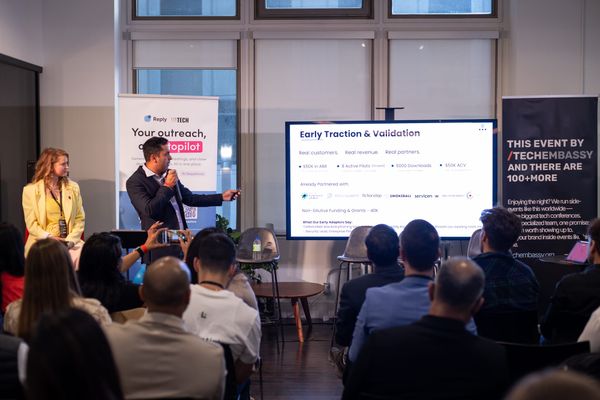
At TechEmbassy, we've just wrapped our first international fintech season, and it's time to look back. Over the course of about six weeks, the team made it to three continents: Bangkok for Money 20/20 Asia in April, Toronto for Tech Week at the end of May, and Amsterdam for Money 20/20 Europe in early June. Nineteen startups took the stage across three pitch sessions, and five of them walked away with a win. We've pulled the season's strongest pitches together in one place.
A Word from Svitlanka
“When Finnovation Days existed only as an idea scribbled in my notebook, I kept asking myself a very simple question:
What opportunity would I have been grateful for when Neofin, the company I am running in the fintech and lending automation space, was still just a dream?
Back then, we were building what is now a geography-agnostic lending infrastructure platform with a rather ambitious belief that modern credit products should be easier to launch, easier to scale, and accessible to businesses anywhere in the world. Like many founders, we were trying to understand where we fit in a highly fragmented global fintech ecosystem. We were looking for meaningful conversations with operators, investors, infrastructure providers, potential partners, and people who had already solved problems we were only beginning to encounter.
And while there are many fantastic conferences in fintech, I often felt there was room for something slightly different. Not another stage where founders pitch into the void. Not another networking reception where everyone exchanges LinkedIn profiles and moves on.
I was seeking a place where fintech builders could meet people who genuinely understand what it means to build in this industry. People dealing with regulation, fraud, underwriting models, payment orchestration, embedded finance, compliance, treasury, stablecoins, AI governance, banking partnerships, and operational scaling every single day.
That thought eventually evolved into Finnovation Days.
Today, fintech looks very different from what it was even five years ago.
Launching financial products is no longer reserved for banks. Embedded finance has become infrastructure. Stablecoins are moving into mainstream financial conversations. AI is rapidly becoming an operational layer inside financial institutions. Open banking, Banking-as-a-Service, agentic systems, and mature compliance tooling are reducing barriers that historically required years of engineering effort and significant capital to overcome. Paradoxically, while fintech has become more complex, it has also become more accessible. A small team with strong domain expertise can now build products that would have required entire institutions not long ago.
And this is exactly why I genuinely believe there has never been a better time to start a fintech.
Throughout our first Finnovation Days season, I had the privilege of meeting founders building payment orchestration platforms, loyalty infrastructure, cybersecurity solutions, digital asset products, wealth experiences, lending technologies, and embedded banking capabilities. Some are just starting out. Others already serve institutions, governments, and millions of users.
What unites them is not necessarily the technology they build.
It is the willingness to solve difficult problems in one of the most regulated, competitive, and consequential industries in the world.
My hope is that Finnovation Days becomes the kind of opportunity I personally would have appreciated years ago: a place where fintech founders can learn faster, meet the right people earlier, and feel that they are building alongside a community that genuinely wants them to succeed.
Because if there is one takeaway I continue coming back from every Money20/20, every Finovate, every Tech Week, and every founder conversation with, it is this:
Fintech is far from done evolving.
In many ways, it feels as though we are only entering its next chapter.”
Startups to watch this season
Before we get to the full lineups, here's a closer look at the ten projects that stood out to us most this season.
Bangkok opened the season, and opened it with a winner.
HeyMax, a Singapore-based open-loyalty platform that brings bank, airline and hotel loyalty programmes together under one currency, Max Miles, took the win at the Money 20/20 Asia pitch session. The company was founded in 2023 by a team of ex-Meta engineers and has already raised an $11M Series A led by Peak XV Partners. HeyMax was represented on stage by David B. Wang, who joined the team after HeyMax acquired his own venture Krip, a Hong Kong credit-card deals platform.

Alongside the winner, two more Bangkok projects stood out.
Paywint is a US-based (Austin, Texas) digital wallet for businesses that brings ACH, RTP, wire transfers, cards and a crypto wallet into one interface, with support for instant cross-border payments powered by stablecoins; it was presented on stage by founder Dr. Saheer Nelliparamban, a member of the Forbes Business Council.
And Turing Space, a company born out of the UC Berkeley startup ecosystem, showed off its TrustTech blockchain platform for issuing and verifying digital certificates and credentials, already used by over 550 organisations and 40 government bodies across 12 countries. The startup was represented by Cynthia Lin.
Toronto sent four projects into our shortlist, and it's where the season handed out two wins at once.
Hi Finance is a Canadian fintech that helps students get a handle on their finances — unlocking grants, building savings habits, and filing taxes. The company started as a student project at the University of Alberta and now partners with university communities and financial advisors across the country; founder Zachary Prusko presented on stage.
The second win went to Apprify, a fintech venture from Ukraine presented on stage by Dmytro Gusakov.

Beyond the winners, two more Toronto projects made a strong impression. DefenceNet (Datacove) is a product from Datacove.ai, a Canadian company founded by serial entrepreneur Vivek Ghärtan: it uses patented AI to block phishing and smishing attacks in real time for individuals, businesses and telecom carriers, and has already been selected for one of Canada's leading cybersecurity accelerator programmes.
And Loanova is gearing up to launch Canada's first fractional investment platform for syndicated mortgages, letting everyday investors put small amounts into a pool of mortgage loans with returns above a standard GIC, while giving borrowers who don't fit traditional bank criteria access to financing; founder Nathan Saliagas presented the project.
The season's final stop was Amsterdam and Money 20/20 Europe
The Pitch Competition went to Gain Technology, a Swedish-Finnish startup building loyalty infrastructure for banks that lets financial institutions launch merchant-funded cashback programmes without building from scratch. Founder Rasmus Savander previously worked at Truecaller, Dreams and Token Terminal, and the company is part of the Mastercard Lighthouse FINITIV programme for Nordic and Baltic fintechs.
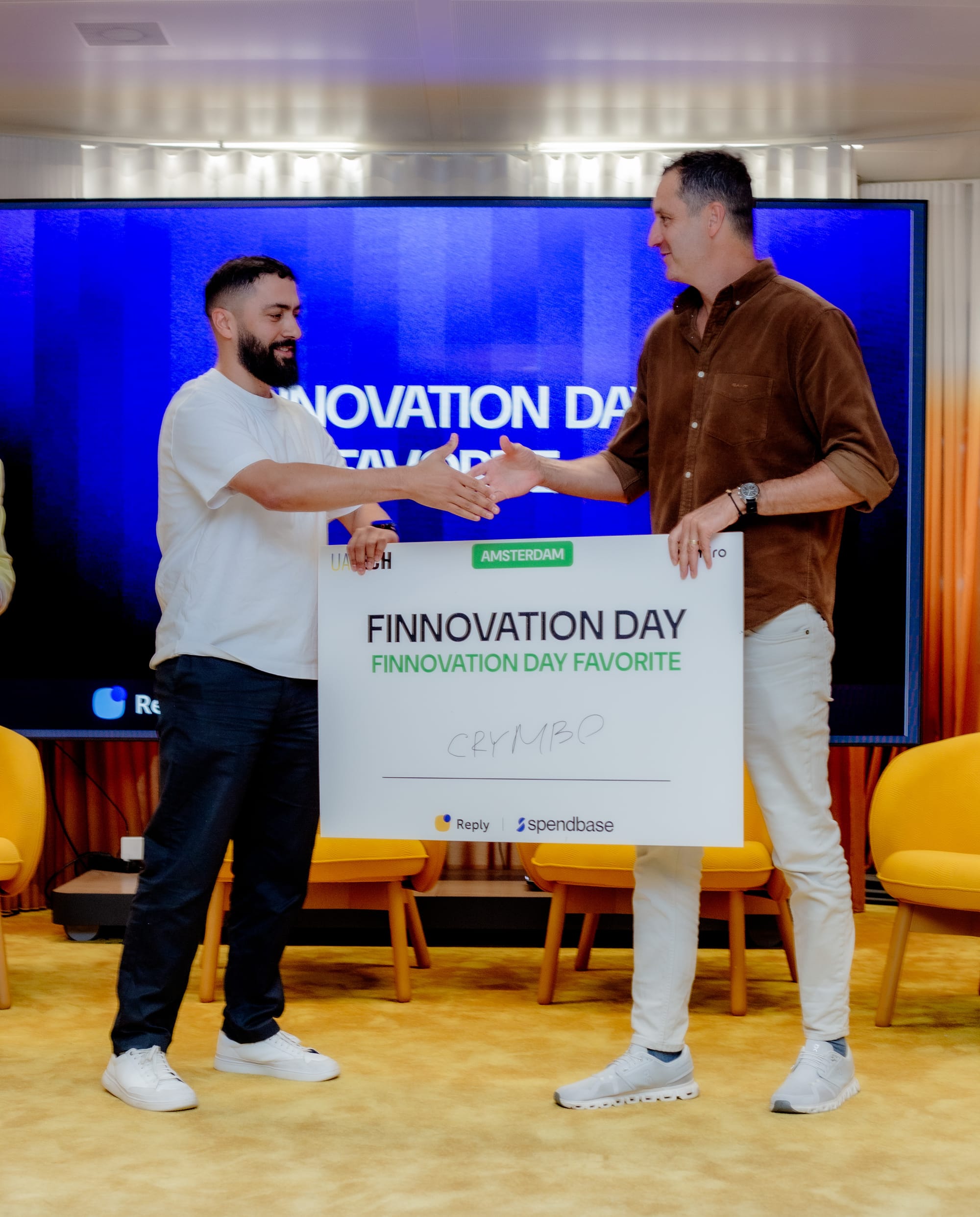
The Venture Night Favorite title went to CRYMBO, an Israeli orchestration platform that unifies traditional finance, CeFi and DeFi infrastructure through a single API, letting banks plug in digital-asset products without months of integration work; it was presented on stage by founder Eyal Daskal, who spent 15 years in banking before starting the company.
Rounding out our top ten is SoftBees, a Ukrainian SaaS platform for banks and payment providers that lets them launch digital banking products — neobanks, payment systems — in weeks rather than months. Over four years the team has delivered seven fintech products across different markets, and CEO and co-founder Tetiana Dashevska spoke on a dedicated media panel at Money 20/20 Europe.
That's not the whole story, though. Here's everyone else who pitched this season, and each did a fantastic job.
In Bangkok, the lineup also included DataSafe-Sign (Casey Regan) and Yulio (Lynn Thit).
In Toronto: Rolla (Kemi Bolatito), Servat (Arian Azari), and Amadeus Protocol (Van Catha).
And in Amsterdam: VIRGOSOL (Tankut Tümay), Tradezen Analytica Inc. (Aleksandar Protic), Okoora (Sami Yutcis), and CurrencyGuard Ltd (Rudi Alexis).
Season in numbers
And that's a wrap on UATech's first fintech season: 3 events across three continents, 19 startups on stage, and 5 teams who took home a win. We saw bold ideas in digital payments, cybersecurity, loyalty infrastructure, and Web3 — and we're already wondering what next season has in store.
Thanks to everyone who stepped on stage!